.svg)

.svg)
.svg)
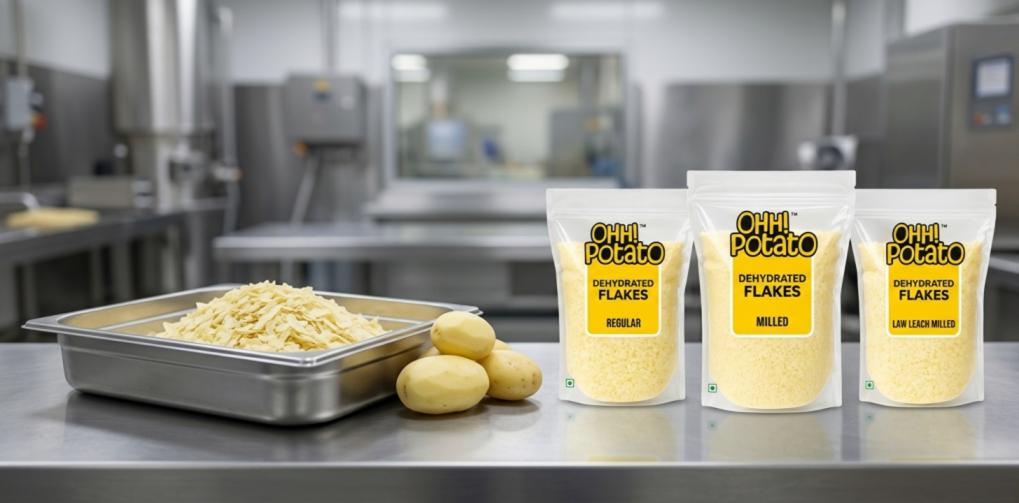
For many food manufacturers, potatoes are more than a basic ingredient. They are part of products made in large volumes and distributed across different markets. That makes the way potatoes are handled, stored and processed an important part of production planning.
Fresh potatoes have traditionally been used across food manufacturing. However, they also require several processing stages before they are ready for use. Cleaning, peeling, cooking and further preparation can add time and labour to a production line.
Potato flakes offer a different approach.
Made from cooked and dehydrated potatoes, flakes give manufacturers a processed potato ingredient that can be rehydrated and incorporated into a wide range of recipes.
So, what is driving food companies toward potato flakes?
A fresh potato does not go directly from storage into most finished food products.
Depending on the application, it may need to be sorted, washed, peeled, cooked and processed before reaching the required form.
At a small scale, these steps are manageable. At an industrial scale, however, every additional stage requires equipment, labour, water, energy and production space.
For manufacturers operating large production lines, reducing unnecessary processing steps can have a meaningful operational impact.
Potato flakes essentially move part of the potato-processing work earlier in the supply chain.
The potatoes have already been cooked and dehydrated before the flakes reach the food manufacturer.
Instead of starting with a raw potato, the manufacturer receives an ingredient that can be prepared according to the needs of the final formulation.
This can simplify the way potato is introduced into a production process.
Consistency is one of the biggest concerns in commercial food production.
A product made today should deliver a similar result when it is produced next week or several months later.
Fresh potatoes can naturally differ in moisture, size, texture and other characteristics. These variations can influence the way they behave during processing.
Potato flakes provide a more standardized ingredient format. When manufacturers work with consistent product specifications, they can have greater control over the potato component of their recipe.
That does not remove the need for quality control, but it can make ingredient management more predictable.
Storage is another factor manufacturers need to consider.
Fresh potatoes require appropriate storage conditions and regular handling. Large volumes also require sufficient storage capacity.
Potato flakes, being dehydrated, are handled differently. When stored in suitable packaging and under the recommended conditions, they can be maintained as a dry ingredient until required for production.
For companies managing multiple ingredients, this can make inventory planning more straightforward.
One of the strengths of potato flakes is their versatility.
They can be incorporated into a range of food products, depending on the formulation and processing requirements.
Common applications include:
This makes potato flakes relevant to manufacturers working across different food categories rather than a single product segment.
Food manufacturers work with precise formulations.
When fresh potatoes are used, their natural moisture content can vary. This can influence the amount of water and other ingredients required in a recipe.
Potato flakes are dehydrated, so manufacturers can rehydrate them according to the formulation.
This gives production teams another way to control the potato component of a recipe and maintain the required product characteristics.
Processing fresh potatoes can create material such as peels and trimmings.
The amount depends on the potato quality, processing equipment and the final application.
With potato flakes, the initial potato processing has already taken place before the ingredient reaches the manufacturer.
This means the manufacturer does not need to repeat those initial preparation stages at its own facility.
Not necessarily.
Fresh potatoes remain essential for many applications where their natural characteristics are an important part of the finished product.
Potato flakes simply offer another ingredient format.
The decision between fresh potatoes and potato flakes depends on several factors, including the recipe, production equipment, product specifications, storage setup and required output.
Food production is becoming increasingly focused on efficiency without losing control over quality.
Manufacturers need ingredients that fit their production systems, work consistently and can be managed at scale.
Potato flakes can meet some of these needs by offering a convenient form of potato that is easier to store, handle and incorporate into different formulations.
For businesses working with potato-based ingredients, Ohh! Potato is part of this broader food-processing space, supporting the growing demand for processed potato products across different food applications.
The potato industry is no longer limited to selling potatoes in their fresh form.
Advances in food processing have created several formats that allow manufacturers to use potatoes in ways that suit modern production.
Potato flakes are one example.
Their value comes from turning a familiar agricultural product into a practical ingredient that can be stored, measured, rehydrated and used across different food formulations.
The shift toward potato flakes is not simply about replacing fresh potatoes.
It is about giving food manufacturers another way to work with potatoes.
For some applications, fresh potatoes remain the natural choice. For others, the convenience, consistency, storage characteristics and flexibility of potato flakes can make them a practical ingredient.
As food manufacturers continue to balance production efficiency with product quality, processed potato ingredients such as flakes are likely to remain an important part of the wider food-processing industry.
1. What are potato flakes used for?
Potato flakes are used in foods such as instant mashed potatoes, snacks, soups, fillings, bakery products, and processed food recipes. They add potato flavour and texture while making production easier.
2. Are potato flakes better than fresh potatoes for food manufacturing?
For many food manufacturers, potato flakes offer easier storage, consistent quality, and faster preparation. Fresh potatoes can still be preferred when the recipe requires freshly processed potatoes.
3. Why do food companies use potato flakes?
Food companies use potato flakes to simplify processing, maintain consistency, reduce preparation time, and manage potato ingredients more easily in large-scale production.
4. How long can potato flakes be stored?
When stored correctly in a cool, dry place and protected from moisture, potato flakes can have a much longer shelf life than fresh potatoes. The exact shelf life depends on the product and packaging.
5. Can potato flakes be used in different food products?
Yes. Potato flakes are versatile and can be used in snacks, mashed potato products, fillings, bakery items, coatings, and other processed food applications.


.svg)
.svg)


.webp)